Hexcrawling With Tarot Cards (Part 1)

A game about traveling must have robust travel rules. Ideally, these should be more than a series of Survival/Forage/etc. rolls, and have a high enough degree of complexity so that player choice matters: terrain, speed, roads, obstacles, factions, and so on, all these should impact choice and consequence. Doing this without the whole thing becoming weary and cumbersome... therein lies the challenge.
When writing Peregrine, I wanted choice, constraint, and consequence to matter without having to stop the game for boring calculations and rolls – especially when these are done by the GM rather than the players. The whole process should be focused on the map, the route, the terrain, the journey, and the players. They are, after all, the ones traveling.
Tarot & Traveling: Match Made in Heaven?
Travel is about living the story of the journey. Perhaps more importantly, its about the ability to retell said story. Role-playing games always hover at that uncertain point between narrative recounting and dramatic enactment, between past and present. The player enacts; the GM recounts. That's how it often works.
An itinerary is always both list and narrative. Tarot cards laid out on the table in a horizontal spread: one by one, each represents a moment of the journey. Here we met a strange beast. Here we grew tired and had to rest. Here it suddenly began to rain. Here we heard those sounds from the mist. A day of travel laid out in before you, each card a tiny portrait of a memorable incident.
This has been the greatest advantage of cards over dice when it comes to traveling, and what I wanted to capture in Peregrine: telling and retelling, together in the same game action.
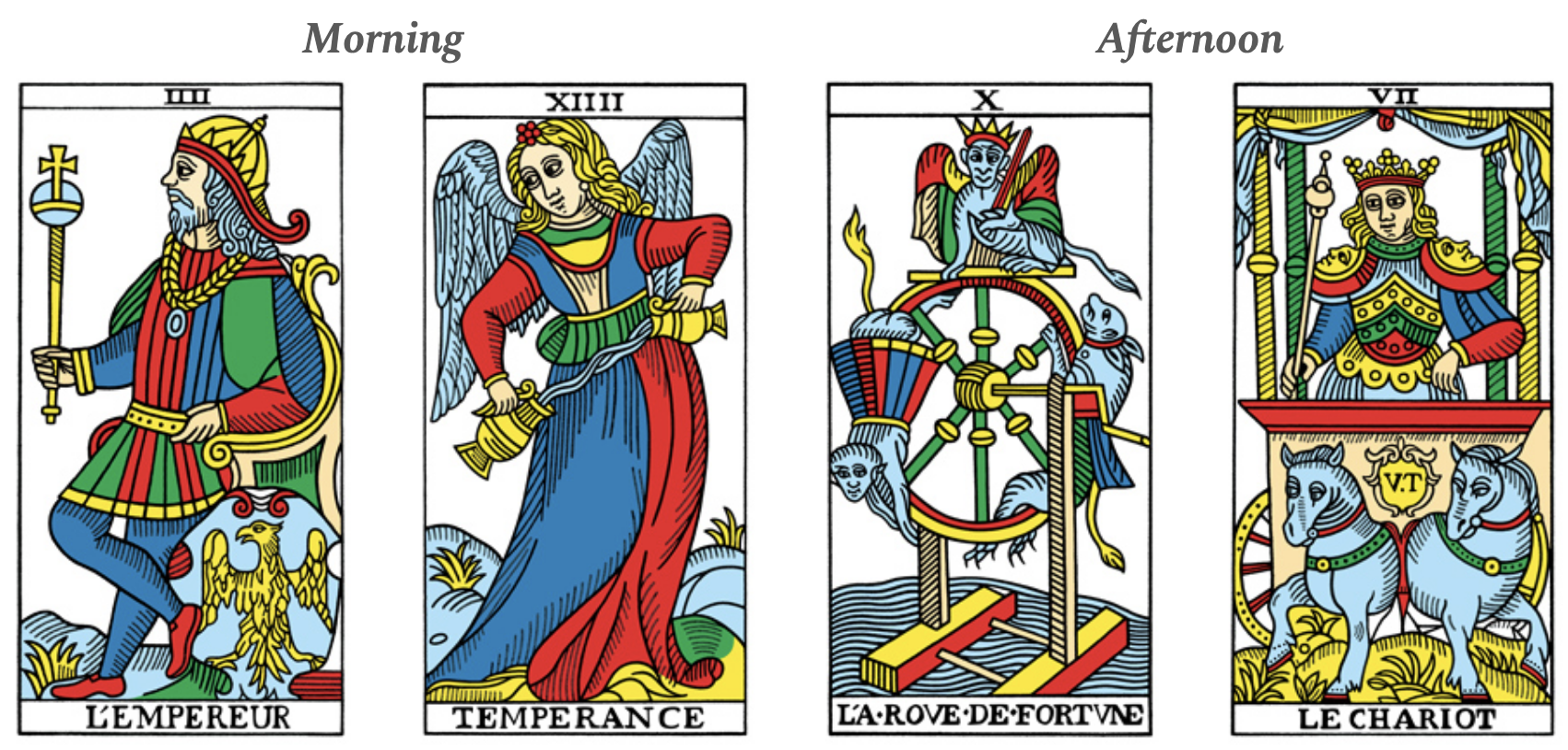
"In the morning, we stopped by the village of Friar's Stump (IV. The Emperor – Hex Feature) hidden away from the road and full of nice people. This came an opportune moment, as our water had just run out (XIV. Temperance – Provisions, Water). Later that afternoon, just as Lina twisted her ankle (VII. The Chariot – Travel Mishap) we heard those terrible scraping sounds again – metal against metal (X. Wheel of Fortune – Spoor/Encounter). We should really stop and recover, but we'll need to be extra careful tonight.”
In this post, I'll explain how I do hexcrawls in Peregrine. In future posts, I'll cover everything else that matters (to me) for a meaningful travel-game experience:
- Pace of Travel & Modes of Movement;
- Tasks (Foraging, Hunting, etc.);
- Terrain Types;
- Resting & Camping;
- Abstracted travel (when hexcrawling is unnecessary);
- more?
Hexcrawling with Tarot Cards
Travel Events
For each phase spent not resting, the GM draws twice on the Travel Events table, drawing two cards from the Major Arcana Deck. The GM should interpret, adjudicate, and describe the Events as they happen simultaneously – if the weather changes while they meet a friend on the road, perhaps the friend calls them for shelter. Do the two events happen at the same time? One after the other? It's up to the GM to decide.
Travel Spread
When drawing Travel Events, set the cards next to each other on the table: this is a Travel Spread. Each new travel event will be added to the right of the previously drawn cards. The Travel Spread grows until the party stops to rest.
Minor Arcana
Some Travel Events, such as Spoor or Weather, ask you to draw a card from the Minor Arcana Deck in order to decide on a random outcome. Add each of those cards to the Travel Spread under the corresponding Major Arcana. If you draw The Fool, add it to the spread and draw again.
Resting and Fatigue
When you stop to rest, count all the cards in the Travel Spread. Then, each player draws from the Minor Deck: if the value of the drawn card is lower than the number of cards on the Travel Spread, they gain 1 Fatigue. In short, you can travel for as long as you want: two phases spent traveling average at around a 50% chance of gaining fatigue, but traveling for longer drastically increases those odds.
Travel Events Table
| Major Arcana | Result |
|---|---|
| III. The Empress, IV. The Emperor | Hex Feature Run into a Landmark or Hidden feature in the current hex. |
| VI. The Lovers | Ally Abroad Meet an unexpected ally. |
| VII. The Chariot, XII. The Hanged Man | Travel Mishap Draw from the Minor Deck. |
| VIII. Justice | Enemy Abroad Meet an unexpected enemy. |
| IX. The Hermit, XVII. The Star | Lost! Draw from the Minor Deck to determine direction. |
| X. Wheel of Fortune, XIII. —, XV. The Devil, XX. Judgement | Spoor or Encounter Draw from the Minor Deck and check the region’s table. A Spoor always announces its corresponding encounter. |
| XI. Strength, XIV. Temperance | Provisions A food item goes bad or water is depleted. |
| XVI. The Tower, XIX. The Sun | Weather Draw from the Minor Deck and check the region’s table. |
| XVIII. The Moon, XXI. The World | Curiosity A noteworthy sight. Might provide a small bonus or hindrance. |
| I. The Magician, II. The High Priestess, V. The Pope | Nothing Add card to spread and continue journey. |
Descriptions
Hex Feature – III. The Empress, IV. The Emperor
As they move into (or in) their current hex, the party finds either a Landmark or Hidden location that they haven't found before. If there are none left, treat the result as a Curiosity instead.
Ally Abroad – VI. The Lovers
This and "Enemy Abroad" inspired by Robert Conley's (Bat in the Attic) rules
The party runs into an acquaintance who would otherwise not be found in the current location. The acquaintance is randomly selected from among the factions with whom the party has a positive relationship.
Travel Mishap – VII. The Chariot, XII. The Hanged Man
Accidents which, as they say, happen. Draw from the Minor Deck and consult the Travel Mishap table:
- Item misplaced. Someone left something behind... Each player draws from the Minor Deck and adds their Mind. Lowest value randomly chooses 1 item in their Physical Inventory: the selected item got left behind, and the party must spend the next phase Searching their current location if they want to find it;
- Dizzy. Whether from eating from a bush they shouldn’t or a poor breakfast, someone is feeling bad. Each player draws from the Minor Deck and adds their Weird. Lowest value gains 1 Fatigue;
- Twisted Ankle. Someone tripped and now can’t walk properly. Each player draws from the Minor Deck and adds their Might. Lowest value gets -1 to Attack, Riposte, Dash, and Dodge spreads until rest;
- Quarrel. Someone got into a heated argument. Each player draws from the Minor Deck and adds their Grace. Two lowest values gain 1 Stress;
- Rats! Something gnawed its way into the food supply and took 1 portion of food.
- Torn Clothing You should really have been more careful... Character with lowest xp gets -1 Courtesy until mended.
- Idle Hands... Too much time to think... Confront your Bane (coming soon).
Enemy Abroad – VIII. Justice
The party runs into an acquaintance who would otherwise not be found in the current location. The acquaintance is randomly selected from among the factions with whom the party has a negative relationship.
Lost! – XIX. The Hermit, XVII. The Star
The party is lost and wanders around in a random direction. Draw a card from the Minor Deck to establish which direction you took and place it face-down in the spread under the travel event card. If the party has a Guide, the card is placed face-up instead. The value of the drawn card is halved (1 to 7) to determine a random direction; on a 7 the party went in circles and didn't leave their current hex. Guides can also make a Test of Might to ignore The Hermit draw, halving the probability that they get lost.
Spoor/Encounter – X. Wheel of Fortune, XIII. —, XV. The Devil, XX. Judgement
The party runs into signs, tracks, omens of the beings who inhabit this place or are just passing through. The GM draws from the Minor Deck and checks the region’s table. The first time you add this event to a Travel Spread, the result is always a Spoor, and its corresponding encounter is activated. The next draw is always the encounter, with the exception of the XIII. — Arcana. The nameless arcana is always an Encounter, whether or not a Spoor has been drawn.
Note: This makes it a 1 in 21 chance that the players simply run into a random encounter with no warning.
Provisions – XI. Strength, XIV. Temperance
A random food item goes bad.
- XI. Strength: A random food item goes bad. Choose a character first, and a food item in their inventory second. If the chosen item is prepared against rotting in some way (salted, dried, pickled) ignore the result.
- XIV. Temperance: Water is depleted. The party must find a water source or gain 1 Stress per phase. Ignore if next to a water source.
Weather Event – XVI. The Tower, XIX. The Sun
The weather changes dramatically. The GM draws on the Weather Chart for the region the party is currently in and moves the marker twice in the drawn direction.
Curiosity – XVIII. The Moon, XXI. The World
An inoffensive sight, providing flavor to the party’s travels. Might provide a small bonus or hindrance. The GM draws from the Minor Deck, checks the region’s table, and adds the drawn card to the Travel Spread under the travel event card.
Example
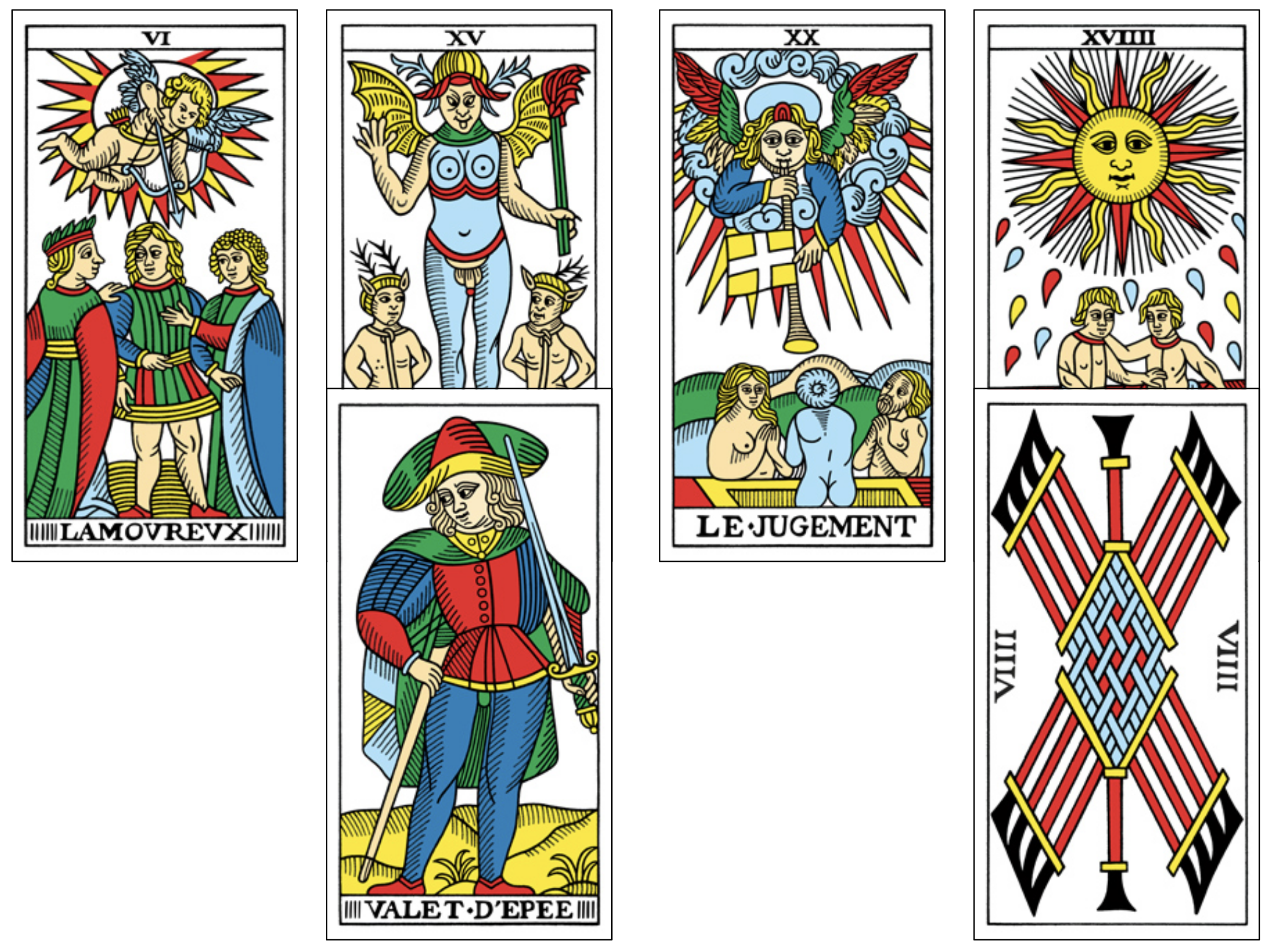
Morning
During the first phase of travel, the party draws VI. The Lovers, Ally Abroad, and XV. The Devil, Spoor/Encounter.
- Ally Abroad: They have three factions with whom they enjoy a positive relationship, so the GM randomly selects one: The Bookhouse Boys, the anarchic group of bibliophile thieves who live hidden among the dense canopies of Häxanmere;
- Spoor/Encounter: Since this is the first draw of its kind in the current Travel Spread, it is a Spoor rather than an Encounter. The GM draws from the Minor Deck, adds the card to the Travel Spread, and consults the region's random encounter table for the 11th entry: Psionic Snail.
"Resting upon the green grass are large tracks of a gooey, faintly glowing substance – still wet. Your eyes trace its path up the hill until you spot a young man with a knapsack, dressed in a rabbit fur vest. You quickly recognize him as Antoine, one of Gaspard's right-hand men, who helped you escape after the botched Von Apfelbaum heist. It's strange to see a Bookhouse Boy so far from the forest, out in the open like this. Oblivious to his surroundings, Antoine touches the goo in a an investigative manner, holding it in his hand, smelling it, and even venturing a small lick. What do you do?"
Afternoon
Antoine decides to accompany the party for a time. During the second part of the day, the party draws XX. Judgement, Spoor/Encounter, and XIX, The Sun, Weather.
- Spoor/Encounter: Since the Travel Spread already contains a Spoor, there's no need to draw again – it's the Psionic Snail that left those marks on the ground.
- Weather: Drawing on the Minor Deck yields a Nine of Clubs. Nine divided by two is 4,5; rounding up gives 5. Consulting the weather hexflower chart, the result is Wind.
"The northern wind starts to blow as the sun goes down. Antoine, visibly excited, is the first to spot it: a huge Psionic Snail, slowly and deliberately moving away from you. The wind picks up, howling in your ears. What do you do?"
Resting?
After dealing with the Psionic Snail, the party might decide to rest for the day – they do. They count the cards in the Travel Spread: six. Each player must draw from the Minor Deck. If they draw lower than six (5/21 chance, ~24%), they gain 1 Fatigue. Nothing a good dinner and rest can't fix.

Some Notes
Phases & General Procedure
A day is divided into 3 phases: Morning, Afternoon, and Night. Each phase takes roughly 8 hours, during which it is presumed that the party stops to rest, collect resources, chat, survey its surroundings, and other activities besides simply moving.
- At the beginning of each phase, the party decides on a Course of Action for that phase;
- If moving, the party decides their Pace of Movement (normal, brisk, swift);
- Each member of the party chooses a Job (Scout, Forage, Guide etc.);
- The GM draws twice on the Travel Events table;
- Repeat until the party stops to rest.
Region Tables
Each region has its own random encounter table and curiosity table. I also use a hexflower chart to track weather, with each region having four hexflower charts, one per each season. Moreover, the Travel Mishap Table shown above is a general purpose one: some regions have their own custom mishap table, tailored to the particularities of the terrain.
Food & Water
I want to motivate players to take care of their food and think about food items as perishables. Namely, I want them to be creative about finding ways to preserve food. As for water, it is important, but I find it best not to track it too minutely. You have it until you don't, and then it becomes a priority.
Getting Lost
If travels matters, then the possibility that one gets lost should exist. Yet, endlessly searching for a way back is unnecessary and annoying. I don't think players should wander about for an indeterminate amount of time or be compelled to search for a "vantage point" in order to figure out where they are. If they have a Guide, they know where they are, the real cost being time and resources. Most of the times that's what being lost is anyway. Places where being really lost is important, such as enchanted forests, should be handled differently anyway, and depthcrawls are probably better suited for the effect.
Thank You For Reading!
The post is getting long, and I hope I managed to convey how I do Travel Events during hexcrawls. There are other aspects to discuss regarding these rules, and so Part 2 (and 3?) will follow with whatever was left out.